We welcome new partners and cherish our network of friends and allies. Being a CCA ally means that your organization is sympathetic to our mission - please read the Carfree Manifesto - and you are open to cooperation and being a part of our network. You can receive our monthly newsletter and will be first in line to be invited to attend our conferences or join us on projects. There is no membership fee.
Please fill out this simple form to add yourself as an ally.
Build Back Better Cities Campaign

Rubin Singh Maharjan, Lead Researcher/ Joint Secretary, Nepal Cycle Society
3 jun 2026
“पाटन पाइलै पाइलामा” (Patan at every step)
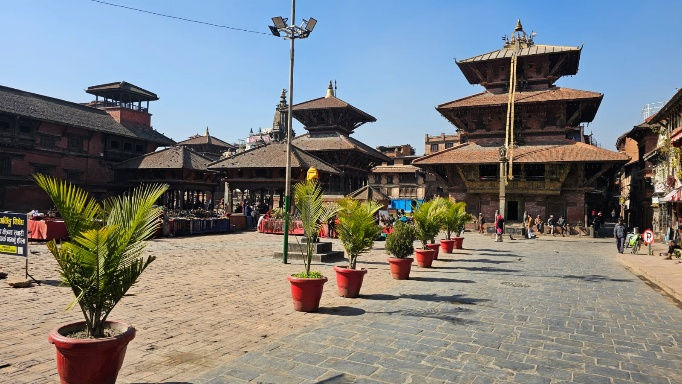
Let’s close our eyes and imagine there are no vehicles on the major streets around Patan Durbar Square, children are playing outside and elderly people are chatting and resting on our ancient “Falchas”/ resting place, the sound of people greeting each other saying “Tare Mam”, and the sound of early morning and evening “Bhajan”/ musical rituals that preserve the essence of heritage area.
Patan Durbar Square had such rhythm for many generations and this environment was how people connected with each other. However, the rhythm we see now is totally different with the growing haphazard urbanization and commercialization. Encroachment of vehicles and disorganized parking has limited the outdoor activities of children as well as the elderly.

Recalling my childhood days, where I used to play in the narrow streets surrounding Patan Durbar Square, I can only shake my head, as I see this now turned into a parking zone. The “Falcha” was once a place to sit and relax, but is now empty due to fast-moving vehicles. Due to unsafe road conditions, children are now thrust into the digital world, keeping them away from community socialization. This detachment in the long run will directly affect their physical, psychological and social wellbeing. The heritage areas around Kathmandu Valley are the significant spots that keep the ancient rhythm and culture alive. But with the increasing road traffic, pollution, and safety hazard, this social space has been compromised.
Welcoming a greater number of vehicles inside the heritage zone will also invite more congestion. When congestion is mentioned in public discourse it is always treated as technical problem with a technical solution, like the extension of a street, the building of flyovers and overhead bridges. But in reality, this approach abandons the street user’s perspective of social interaction and community amenities. I believe that the heritage zone of Patan Durbar Square was never designed for cars. According to the recent data from World Bank it shows that nearly 90 percent of Lalitpur’s inner-city streets are less than three meters wide. Yet they are expected to accommodate large vehicles entering the narrow streets of the heritage zone. Even electric vehicles, despite environmental benefits, occupy the same space and create the same dangers on narrow streets.
With this encroachment by the vehicles, pedestrians are pushed aside, and it becomes less safe for children to play. Elderly people have been losing their resting place (especially the Falcha) which directly shrinks social interaction. This fosters mobility without any meaning in the heritage zone. The main question here is not how to fit more vehicles into Patan Durbar Square. The real concern is why we continue to allow their intrustion into such a space. Thankfully, an initiative by Lalitpur Metropolitan City under City Pride Project, supported by Nepal Cycle Society “पाटन पाइलै पाइलामा” has directly confronted these recent trends: a two-month trial of a vehicle free zone (cars and motorbikes) was launched. The trial created a hopeful moment, and underscored the importance of prioritizing this issue.
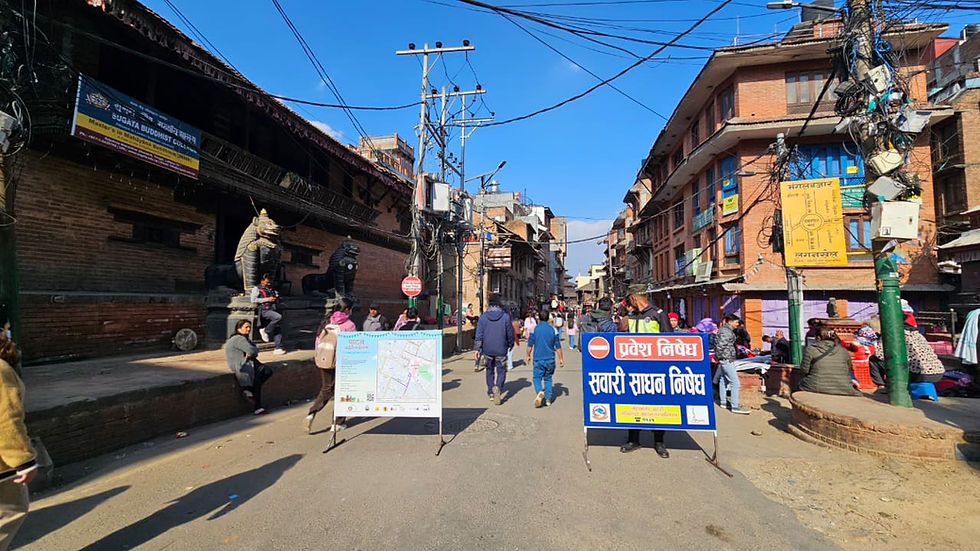
During the vehicle-free trial, we could see some remarkable changes. Streets that were normally covered with vehicles could now be traversed by children; parking spaces were used as play areas. The Falcha (rest spot) regained their purpose. Elderly people and children reclaimed their space. Compared to previously, the number of people walking doubled in several streets and in some streets even tripled. Vehicle traffic dropped by up to 90 percent. Air quality also improved noticeably, dropping below the World Health Organization (WHO) guidelines of PM 2.5, during restricted hours. Noise levels were also minimized compared to the situation before. Pedestrians (especially children and elderly) described feeling safer during the trial.
These outcomes were not at all accidental. They occurred thanks to the removal of vehicles from those areas. We can observe this phenomenon around the world: the specific way that streets and people interact dynamically. According to Donald Appleyard’s landmark studies in San Francisco, streets with heavy traffic produce fewer friendships, weaker community bonds, and a reduced sense of belonging. Mobility patterns (and volume), as they are found in urban spaces, have a direct psychological effect on street users. This experience in Patan confirms the validity of these universal principles.
During the vehicle-free trial, the strongest criticism came from local business owners who feared losing customers. Many argued that shoppers had grown used to riding their vehicles directly up to shopfronts, sometimes making a purchase without even entering the shop. They believed that fewer vehicles would automatically lead to fewer customers. But the trial produced a different result. During vehicle-free hours, businesses did not experience a decline. On busy stretches such as Mangal Bazar to Chakrabahil Chowk, increased foot traffic made the streets feel livable and inviting. Visitors felt safer, lingered longer, and said they would return more often if the streets remained carfree. This shift in perception was reflected in the survey results. Almost 80 percent of the respondents, including local residents, visitors, and business owners, supported continuing or expanding the initiative, which can be considered an impressive majority consensus. In Kathmandu’s Hadigaun district, the Saturday vehicle-free street program is one of the examples that shows why streets that are safer and cleaner draw people to them. In the end, it’s the presence of people, not vehicles, that keeps local businesses flourishing.
It is a part of our human nature that we oppose change. Some local residents worried about their mobility inconvenience. Local Business owners feared losing their business as well as their parking spots. Delivery logistics as well as school bus routes had to be adjusted. Road construction in nearby areas disrupted traffic flows and complicated the mobility patterns. These are some of the challenges that are still there, and they demand better planning. Yet this can be achieved in a way that preserves the maxim of people-centred streets: most of these concerns can be addressed with thoughtful planning by clear delivery time schedule, designated parking areas, alternative access routes, and better coordination of road construction schedules. The most difficult part to solve is the psychological impact on public perception owing to the long-held status quo of vehicle dominance. The process of pedestrianization in other parts of the world attests to the fact that achieving positive change does not necessarily mean rejecting conflict; it is a matter of managing it without compromising the vision.
Patan Durbar Square was listed as a UNESCO World Heritage Site in 1979 and it has its own boundary that is covered with stone inscription; yet heritage will not be preserved by stone alone. It exists due to daily use, ritual, interaction and memory that preserve its essence. Heritage streets should not be a place filled with vehicles honking and a dearth of people walking. In the name of “access” inviting cars into heritage zones attests to a misguided understanding of this concept.
The true meaning of access is where people can freely walk, linger, observe, gather and participate. It is about creating a space for children and elderly to interact and learn by playing. The recent two months of the vehicle free trial has shown a practical example with tangible benefits. But the major question lies whether this experience will be treated as a temporary experiment or as a foundation on which a more people-centric urban future can be built.


